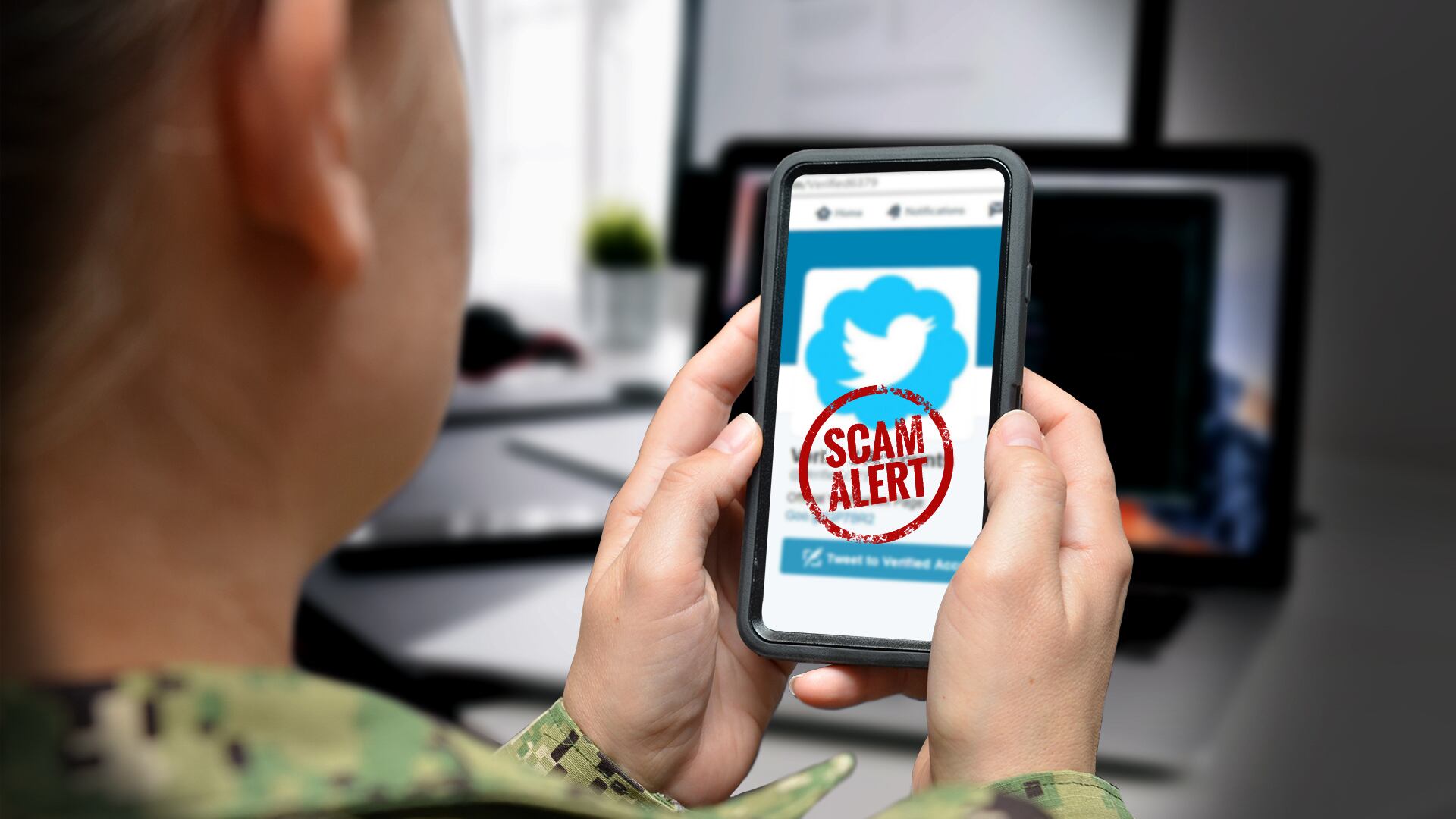
The father of a sailor is out to warn others in the military community about a “Good Samaritan” scam that cost his son thousands of dollars.
On July 2, two men approached the young sailor, claiming they had lost their wallets and needed help paying for a hotel room.
“The men gained possession of his phone under the pretense of entering reimbursement information electronically,” the father wrote in an email to Military Times. “Shortly afterward, he discovered an unauthorized transfer from his Navy Federal Credit Union account.”
Young service members are increasingly targeted by financial scammers who, in recent years, have employed everything from romance and investment schemes to fraudulent debt-relief offers and rental and housing scams during PCS season. Military spouses have also been targeted.
The Federal Trade Commission reported that military consumers, including active duty, veterans and families, lost $584 million to fraud in 2024.
The incident with the sailor, who is stationed in Suffolk, Virginia, occurred around 5:30 p.m. in the parking lot of a Wawa in Norfolk.
The scammers were able to use his banking app to transfer a large sum of money, according to Norfolk Police Department spokeswoman Noel Lipieko.
“These scams only take seconds to complete,” Lipieko said. “Detectives say entry-level military personnel do appear to be disproportionately impacted by scammers and remind everyone to always be cautious about letting someone you don’t know use your cell phone, by politely declining or offering to call for help on their behalf.”
The investigation into the incident is ongoing.
Carrie Foran-Sepulveda, vice president for fraud and physical security strategy at Navy Federal Credit Union, called the scam “digital mugging.” NFCU has seen an increase in these parking lot scams over the last few years, she said.
Military-connected consumers are also particularly vulnerable to scams because of frequent moves and changing addresses, said Jason Stverak, chief advocacy officer for the Defense Credit Union Council.

Defense credit unions, meanwhile, use a multi-layered approach to fight fraud and scams, he said. These efforts include consumer education and employee training, but also extensive oversight of the financial institution’s own systems through real-time transaction monitoring, alerts that allow members to confirm or deny suspicious activity, and other checks.
Financial institutions, tech companies, government agencies and law enforcement, among others, are working together to find ways to prevent these scams and help victims recover money when possible.
“I know the military community is a very giving community,” Foran-Sepulveda said. However, handing someone an unlocked phone “is the difference between handing them a $20 bill and handing them your whole wallet,” she said. “Even the kindest, most generous person is not going to say, ‘Take my ID, take my credit cards, take everything.’”
Parking lot scammers have also used other tactics, such as feigning an emergency, to gain access to a person’s phone and money. Beyond the in-person encounter, fraudulent phone calls, emails and texts have also proven to be a frequent medium for scammers.
A scammer may pretend to be someone else or send a text message that appears like an innocent wrong number before steering the conversation into precarious territory. The unpaid toll violation notice is another common scam, and some have reported getting calls about being imminently arrested due to not showing up for jury duty.
Foran-Sepulveda says Navy Federal and other financial institutions are taking steps to educate their members about the ever-evolving scams.
Financial institutions like Foran-Sepulveda’s are liable when fraud occurs with unauthorized transactions, but not for authorized scams. While financial institutions work to detect fraud internally, the problem takes on new complexity when criminals work directly with the target to set them up for a payday.
“If the scammers can convince you, get that trust built with you before you even open your [financial institution’s] app, there’s just no way for us to know what happened before,” Foran-Sepulveda said. “At some point, it is your money, and we have to let our members make their own choices.”
There are some red flags institutions look for, however, such as wire transactions — especially high-dollar moves. Once such a scam is detected, financial institutions attempt to prevent money from leaving the account.
Foran-Sepulveda said NFCU also works with a company that uses artificial intelligence to “scam the scammer,” getting the account information for the money transfer.
So, if a member wants to send money to what they might perceive as an appealing account, “whatever story [they] might come in with, I feel confident in saying no. ... I know this account is being used to get scam dollars,” Foran-Sepulveda said.
Experts suggest the following when spotting and avoiding scams:
- Watch out for tell-tale signs, including intense pressure to quickly move money.
- Decide on a family code word in case a scammer calls asking for emergency money for a family member “in trouble.”
- Be aware that scammers are now often using AI-generated voice impersonation.
- If you are the victim of fraud or a scam, contact your financial institution immediately and report it to law enforcement.
- Ignore scam texts, but know that they are getting more clever.
- If receiving a call from someone claiming to be from your financial institution, hang up and call that institution directly.
Karen has covered military families, quality of life and consumer issues for Military Times for more than 30 years, and is co-author of a chapter on media coverage of military families in the book "A Battle Plan for Supporting Military Families." She previously worked for newspapers in Guam, Norfolk, Jacksonville, Fla., and Athens, Ga.